Comment: Upon receiving orders to become a Missileer back in 1968, I did an extensive study at the university library regarding the effects of airborne nuclear testing. The results were alarming. Among so many impacts was the increased cancer rates on Eskimo populations due to consuming reindeer who feed on lichen air feeding plants that were absorbing nuclear fallout from the airborne tests. Who would have thought? Second post is AI on Eskimo cancer risk from fallout. Airborne testing is not a good idea when other means are available.
Third post is AI on nuclear weapons testing methods.
Fourth post is AI on computer simulation for nuclear weapons testing.
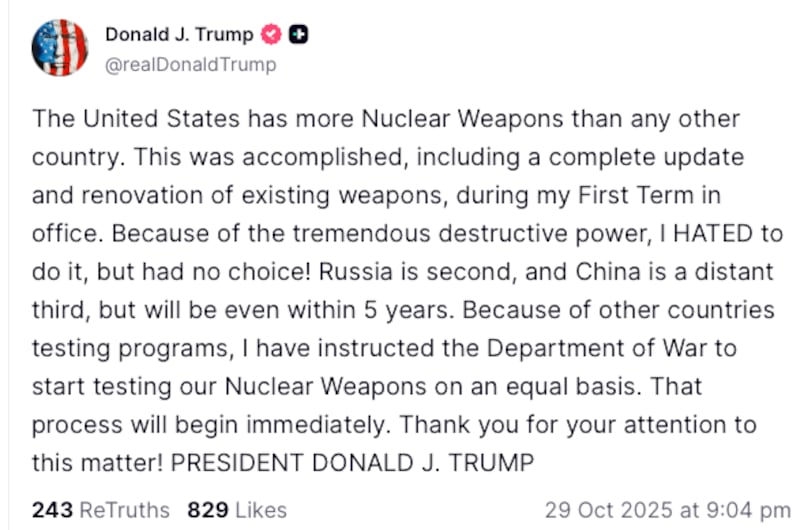
https://www.thenationalnews.com/news/us/2025/10/30/trump-nuclear-test-weapons/
Thomas Watkins Washington Bureau Chief 29 Oct 2025
Quote:
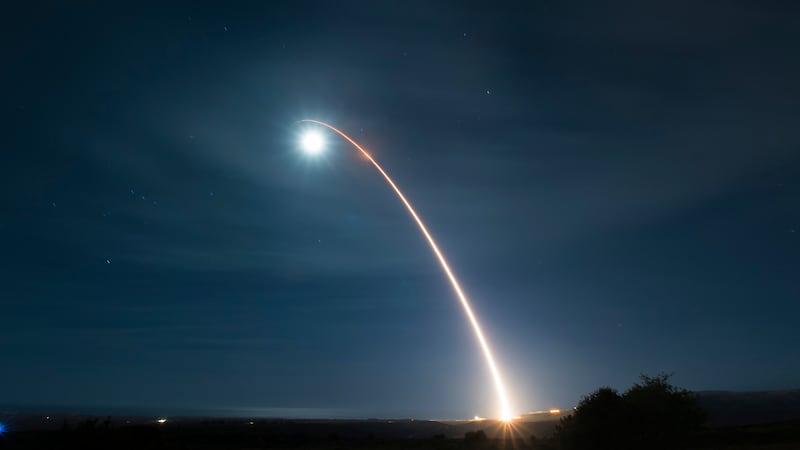
"An unarmed Minuteman III intercontinental ballistic missile during a 2020 test.
US Air Force / AFP"
____________________________________________________________
Search Assist
Airborne nuclear tests have been linked to increased cancer rates among populations living in affected areas, including Indigenous groups like the Inuit. Exposure to radioactive fallout can lead to various cancers, particularly thyroid cancer, leukemia, and breast cancer, due to the inhalation of radioactive particles and consumption of contaminated food and water. downwinders.info
 National Cancer Institute
Impact of Airborne Nuclear Tests on Cancer Rates
Background on Nuclear Testing
Airborne nuclear tests, particularly those conducted in the mid-20th century, released significant amounts of radioactive materials into the atmosphere. These tests affected many regions, including areas inhabited by Indigenous peoples, such as the Eskimo (Inuit) communities.
Cancer Risks Associated with Nuclear Fallout
The fallout from nuclear tests has been linked to various health issues, especially cancer. Key radioactive materials released during these tests include:
- Iodine-131: Associated with thyroid cancer, particularly in children.
- Cesium-137: Linked to soft tissue cancers, including breast and lung cancer.
- Strontium-90: Mimics calcium and can lead to bone cancer and leukemia.
Cancer Rates in Eskimo Communities
While specific data on Eskimo cancer rates directly linked to airborne nuclear tests is limited, general trends indicate increased cancer risks in populations exposed to nuclear fallout. The following points summarize the potential impact:
- Increased Incidence: Communities near nuclear test sites have reported higher rates of thyroid cancer, leukemia, and other cancers.
- Environmental Contamination: Radioactive particles can contaminate food and water sources, leading to long-term health effects.
- Vulnerability of Indigenous Populations: Indigenous peoples often have unique health profiles and may be more susceptible to the effects of radiation exposure.
Conclusion
The effects of airborne nuclear tests on cancer rates in Eskimo communities reflect broader trends observed in other populations exposed to nuclear fallout. Increased cancer risks, particularly for thyroid cancer and leukemia, are significant concerns for these communities. Further research is needed to understand the full extent of these impacts.
 Wikipedia downwinders.info
____________________________________________________________
Search Assist
Nuclear weapons testing methods include atmospheric tests, underground tests, and underwater tests. These tests are conducted to evaluate the performance and effects of nuclear weapons, with atmospheric tests being largely banned since the 1963 Partial Test Ban Treaty. Wikipedia United Nations
Overview of Nuclear Weapons Testing Methods
Nuclear weapons testing involves various methods to evaluate the performance and effects of nuclear devices. These methods can be categorized based on the environment in which the tests are conducted.
Types of Nuclear Tests
| TEST TYPE |
DESCRIPTION |
NOTABLE EXAMPLES |
| Atmospheric |
Tests conducted in the atmosphere, leading to widespread radioactive fallout. |
Castle Bravo (1954), conducted by the U.S. |
| Underground |
Tests performed below the earth's surface to contain radioactive materials. |
Nevada Test Site tests (1945-1992) |
| Underwater |
Tests conducted underwater, primarily to assess the impact on naval vessels. |
Operation Crossroads (1946) |
Historical Context
- The first nuclear test occurred on July 16, 1945, in New Mexico.
- Over 2,000 nuclear tests have been conducted globally since then, with significant testing by the U.S. and the Soviet Union.
- The 1963 Limited Test Ban Treaty aimed to limit atmospheric testing, while the Comprehensive Nuclear-Test-Ban Treaty (CTBT) seeks to ban all nuclear tests.
Current Status
- North Korea is currently the only country actively conducting nuclear tests, with its last test occurring in September 2017.
- Many countries have ceased testing due to international treaties and growing opposition to nuclear proliferation.
These methods and historical developments highlight the complexities and implications of nuclear weapons testing.
Wikipedia United Nations
________________________________________________________________________
Search Assist
Computer simulations for nuclear weapons testing are used to model and predict the performance and safety of nuclear weapons without conducting actual tests. These simulations help maintain a reliable nuclear stockpile by using advanced physics-based models to validate weapon designs and assess their aging effects. National Defense University
 IEEE
IEEE
Overview of Computer Simulations in Nuclear Weapons Testing
Computer simulations play a crucial role in modern nuclear weapons testing, especially since the Comprehensive Nuclear-Test-Ban Treaty prohibits actual nuclear tests. These simulations help maintain and assess the safety and reliability of nuclear arsenals.
Purpose of Simulations
- Modeling Weapon Performance: Simulations are used to predict how nuclear weapons will perform under various conditions.
- Aging Effects: They help in understanding how nuclear materials age and how this affects weapon reliability.
- Safety Assessments: Simulations are essential for evaluating the safety of nuclear stockpiles without conducting physical tests.
Key Developments
- Stockpile Stewardship Project: Initiated by the Department of Energy, this project focuses on developing predictive capabilities using validated, physics-based simulation tools.
- El Capitan Supercomputer: Recently unveiled, this supercomputer can perform over 2700 quadrillion operations per second, significantly enhancing simulation capabilities for modeling nuclear weapon performance.
Simulation Techniques
- 3D Modeling: Advanced simulations utilize three-dimensional modeling to analyze multiple physical processes involved in nuclear detonations.
- Data-Driven Approaches: Simulations incorporate extensive datasets on current nuclear arsenals, weapon yields, and potential targets to provide realistic assessments of nuclear conflict scenarios.
Implications of Simulations
- Risk Assessment: Simulations help in understanding the catastrophic consequences of nuclear conflicts, including potential fatalities and injuries.
- Policy Development: Insights gained from simulations inform nuclear policy and arms control discussions, especially in light of changing geopolitical dynamics.
Computer simulations are vital for ensuring the effectiveness and safety of nuclear weapons in a world where actual testing is no longer feasible.
National Defense University Princeton University